15 Magnificent Castles in Ireland You Should Visit
Ireland’s landscape is filled with magnificent castles, ancient fortresses and romantic ruins, each revealing a different chapter of the country’s fascinating history.
Some were constructed by powerful Norman families determined to control newly conquered territory. Others were built by Gaelic chieftains, wealthy landowners or influential political families. Many witnessed battles, sieges, royal visits and centuries of changing ownership, while others have been beautifully restored as visitor attractions or luxury hotels.
From dramatic ruins overlooking the Atlantic Ocean to beautifully furnished castles surrounded by gardens, these historic landmarks offer visitors an unforgettable journey through Ireland’s past.
Here are 15 of the best castles to visit during a vacation in Ireland.
1. Dublin Castle, Dublin City
Located in the historic heart of Ireland’s capital, Dublin Castle is one of the country’s most politically and historically significant buildings.
The castle was constructed during the early 13th century on the site of an earlier Viking settlement. It served as the centre of English and later British administration in Ireland for centuries before being handed over to the newly independent Irish government in 1922.
Today, visitors can explore the impressive State Apartments, ceremonial rooms, Chapel Royal and sections of the medieval undercroft. The beautifully maintained Dubh Linn Garden provides a peaceful place to walk while surrounded by some of Dublin’s most important historic buildings.
Dublin Castle is within walking distance of attractions including Christ Church Cathedral, St Patrick’s Cathedral, Temple Bar and the Chester Beatty Library, making it an excellent addition to a day exploring Dublin.
2. Malahide Castle, County Dublin
Situated approximately 30 minutes from Dublin city centre, Malahide Castle combines more than 800 years of history with beautiful gardens and extensive parkland.
The Talbot family occupied the castle for almost eight centuries, apart from a short interruption during the Cromwellian period. A guided tour introduces visitors to the family’s remarkable history while exploring elegant reception rooms, historic furniture and an impressive art collection.
The surrounding gardens contain colourful plants, woodland walks and peaceful open spaces. Families can also enjoy the large playground and other attractions located throughout the estate.
After visiting the castle, spend some time exploring the nearby coastal village of Malahide. Its marina, restaurants, traditional pubs and seaside walks make it one of the most enjoyable destinations close to Dublin.
3. Trim Castle, County Meath
Standing beside the River Boyne, Trim Castle is the largest Anglo-Norman fortification in Ireland and one of the country’s most impressive medieval strongholds.
Construction began under Hugh de Lacy and continued for approximately 30 years. Its enormous three-storey keep, curtain walls, defensive ditch and moat created a formidable fortress in the heart of Norman-controlled territory.
Visitors can walk around the spacious castle grounds or join a guided tour of the keep. From the upper levels, there are wonderful views across Trim and the surrounding countryside.
The castle also gained international recognition as a filming location for Braveheart. Trim itself is an attractive heritage town and can easily be combined with the Hill of Tara, Newgrange or other historic attractions in County Meath.
4. Kilkenny Castle, County Kilkenny
Kilkenny Castle stands proudly in the centre of one of Ireland’s finest medieval cities.
Originally built during the 12th century, it became the principal residence of the powerful Butler family for almost 600 years. The castle was extensively remodelled during the Victorian era and has since undergone a major restoration programme.
Inside, visitors can explore beautifully decorated bedrooms, reception rooms, the library and the magnificent Picture Gallery, which was designed to display the Butler family’s important collection of artwork.
The extensive parklands behind the castle are ideal for a relaxing walk or picnic. Afterwards, explore Kilkenny’s Medieval Mile, including St Canice’s Cathedral, Rothe House, traditional pubs, independent shops and narrow historic streets.
5. The Rock of Cashel, County Tipperary
The Rock of Cashel is not a traditional castle but rather an extraordinary collection of medieval buildings positioned on a dramatic limestone outcrop.
Once associated with the kings of Munster, the site later became one of Ireland’s most important ecclesiastical centres. Its surviving monuments include a round tower, Gothic cathedral, high cross, abbey, tower house and the remarkable Romanesque Cormac’s Chapel.
According to tradition, St Patrick visited Cashel and converted King Aenghus to Christianity. Brian Boru is also associated with the site and is said to have been crowned King of Munster there before becoming High King of Ireland.
The elevated position provides magnificent views across the Golden Vale. The nearby ruins of Hore Abbey can be seen below and are well worth visiting during the same stop.
6. Cahir Castle, County Tipperary
Built on a rocky island in the River Suir, Cahir Castle is one of Ireland’s largest and best-preserved medieval castles.
The castle was constructed during the 13th century and became a stronghold of the influential Butler family. Its defensive walls, towers, courtyards and gateways demonstrate how effectively medieval castles were designed to withstand attack.
Although once considered almost impregnable, it eventually fell to the Earl of Essex in 1599 following the use of heavy artillery.
Visitors can explore much of the original structure and learn about its eventful history through exhibitions and an audiovisual presentation. The castle’s authentic medieval appearance has also made it a popular filming location.
Cahir Castle can conveniently be combined with the Rock of Cashel, which is approximately 16 kilometres away.
7. Blarney Castle, County Cork
Blarney Castle is one of Ireland’s most famous attractions and has welcomed visitors from around the world for generations.
The present tower house was built nearly 600 years ago by the powerful MacCarthy family. At the top of the castle is the legendary Blarney Stone, which is traditionally believed to grant the “gift of the gab” to anyone who kisses it.
Reaching the stone requires climbing the castle’s narrow spiral staircases before leaning backwards, with assistance, to complete the famous tradition.
However, there is far more to Blarney than the stone. The extensive estate includes landscaped gardens, woodland walks, waterfalls, caves and unusual areas such as the Poison Garden.
Visitors can also browse Blarney Woollen Mills, one of Ireland’s best-known shopping destinations for Irish clothing, crafts and gifts.
8. Bunratty Castle, County Clare
Built in 1425, Bunratty Castle is considered one of Ireland’s best-preserved medieval strongholds.
The castle’s furnished rooms contain tapestries, artwork and historic furniture, helping visitors imagine how Ireland’s wealthy families may have lived during the medieval period. Its great hall, bedrooms and defensive towers are among the highlights of the visit.
Beside the castle is Bunratty Folk Park, a recreated 19th-century Irish village spread across approximately 26 acres. More than 30 buildings include traditional cottages, farmhouses, shops, a schoolhouse and a Georgian residence.
Together, the castle and folk park provide an excellent introduction to both medieval history and traditional rural Irish life. Bunratty is also conveniently located near Shannon Airport, Limerick and the route towards the Cliffs of Moher.
9. Dunguaire Castle, County Galway
Dunguaire Castle occupies one of the most photographed settings along Ireland’s Wild Atlantic Way.
The compact tower house stands on a small promontory beside Galway Bay, just outside the colourful village of Kinvara. Surrounded by water, fields and the distinctive limestone landscape of the Burren, it is particularly beautiful during the evening when the setting sun reflects across the bay.
Dunguaire became associated with Ireland’s early 20th-century literary revival, attracting writers and cultural figures to gatherings held at the castle.
Even when the interior is unavailable, the roadside viewpoint and short walk around the exterior make this a worthwhile stop. It can easily be included when travelling between Galway, the Burren, Doolin and the Cliffs of Moher.
10. Kylemore Abbey, County Galway
Kylemore Abbey is one of the most recognisable landmarks in Connemara.
Originally constructed as a Victorian castle, the building stands beside a peaceful lake surrounded by wooded hills and rugged mountains. Its beautiful reflection in the water has become one of Ireland’s most famous travel images.
The estate later became home to a Benedictine community and continues to operate as a monastery and visitor attraction. Inside, restored rooms and exhibitions explain the lives of the families and religious community connected to Kylemore.
Visitors can also explore the neo-Gothic church, woodland trails and beautifully restored Victorian Walled Garden.
The journey to Kylemore is part of the experience, passing through some of Connemara’s most spectacular mountain, lake and coastal scenery.
11. Ashford Castle, County Mayo
Ashford Castle offers a very different way to experience Ireland’s castle heritage.
With origins dating to the 13th century, the building evolved from a medieval fortress into an elegant country estate and is now one of Ireland’s best-known luxury castle hotels.
The estate lies beside Lough Corrib near the picturesque village of Cong. Guests can enjoy experiences including falconry, boating, fishing and walks through the extensive grounds.
The castle and surrounding area are also closely connected with The Quiet Man, the celebrated 1952 movie filmed in and around Cong.
Access to the main castle and gardens may be restricted to residents or guests with confirmed reservations, so arrangements should be made before travelling. However, Cong village, Cong Abbey and the wider lakeside setting remain well worth exploring.
12. Ross Castle, County Kerry
Ross Castle enjoys a spectacular position beside Lough Leane in Killarney National Park.
The castle was probably built during the 15th century by the Irish chieftain O’Donoghue Mór. It later became famous as one of the final strongholds in Munster to resist Cromwellian forces.
Local legend claims that O’Donoghue continues to sleep beneath the waters of the lake and occasionally rises on a white horse. Anyone fortunate enough to see him is promised good luck.
Guided tours reveal how a Gaelic tower house functioned, while the lakeside grounds provide beautiful views across the water towards Killarney’s mountains.
Boat trips across the lakes of Killarney regularly depart from the area, allowing visitors to combine the castle with one of Ireland’s most scenic national parks.
13. Donegal Castle, County Donegal
Located in the centre of Donegal Town beside the River Eske, Donegal Castle was once the stronghold of the powerful O’Donnell clan.
The castle was constructed during the 15th century by Red Hugh O’Donnell. Following the Battle of Kinsale, the building was deliberately damaged to prevent it from being used by English forces.
Sir Basil Brooke later became the castle’s owner and added a Jacobean-style manor house beside the original Gaelic tower. The result is an interesting combination of Irish and English architectural influences.
After falling into ruin, the complex was restored during the 1990s. Visitors can now explore its rooms, staircases, exhibitions and impressive carved features while learning about the competing families who shaped its history.
14. Dunluce Castle, County Antrim
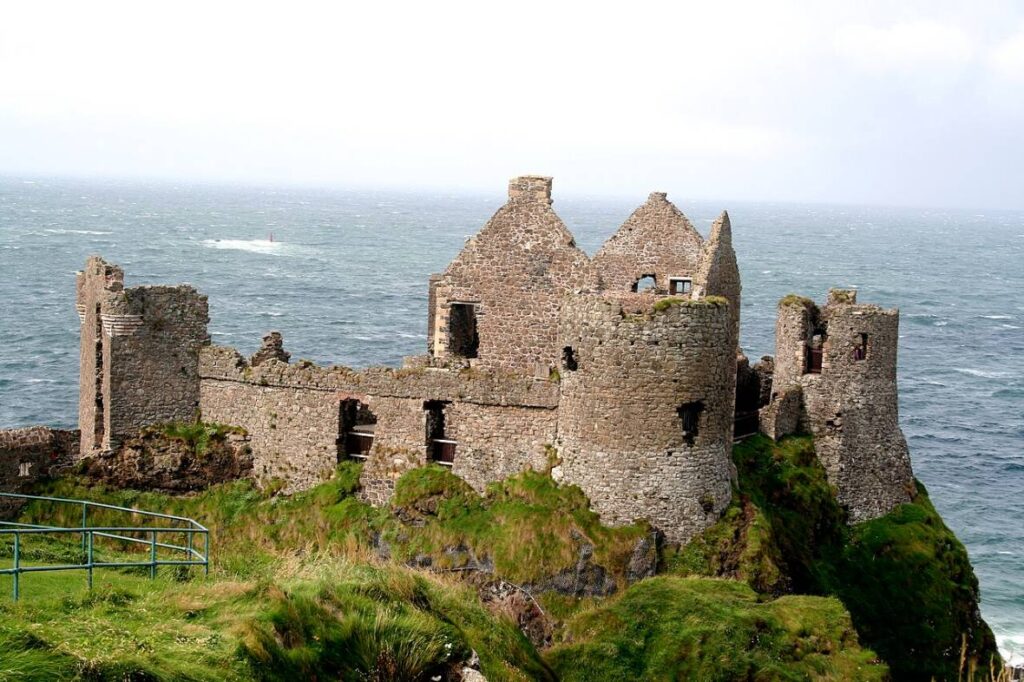
Few castles in Ireland can match the dramatic setting of Dunluce Castle.
Its ruins stand on the edge of towering cliffs above the Atlantic Ocean along Northern Ireland’s Causeway Coastal Route. The castle is separated from the mainland by a deep ravine and is approached by a bridge, creating one of Ireland’s most spectacular historic views.
Although evidence of earlier settlement has been discovered, the surviving castle dates mainly from the 16th and 17th centuries. It was associated with the MacQuillan and later the MacDonnell families, who controlled significant areas of the north Antrim coast.
Dunluce Castle can be combined with the Giant’s Causeway, Bushmills, Ballintoy Harbour and Carrick-a-Rede during a full day exploring the coastline.
15. Carrickfergus Castle, County Antrim
Carrickfergus Castle has guarded Belfast Lough for more than 800 years and remains one of the best-preserved medieval fortresses on the island of Ireland.
The Norman castle was established in the late 12th century and occupied an extremely important strategic position. Over the centuries, it was attacked by Scottish, Irish, English and French forces.
Its strong walls, towers, battlements and harbour setting allow visitors to appreciate both its military importance and impressive construction.
Carrickfergus is located a short distance from Belfast and provides an excellent first stop when beginning a journey along the Causeway Coastal Route. It can also be combined with Belfast’s Peace Walls and murals before continuing towards the north Antrim coast.
Planning Your Irish Castle Adventure
Ireland’s castles are spread throughout the country, so the best way to experience them is to include several as part of a carefully planned day trip or multi-day private tour.
Dublin Castle and Malahide Castle are easily reached while staying in the capital. Trim Castle can be visited during a journey through County Meath, while Kilkenny Castle, the Rock of Cashel and Cahir Castle work particularly well as part of an Ireland’s Ancient East itinerary.
Blarney, Bunratty, Dunguaire and Kylemore can be incorporated into a journey towards the Wild Atlantic Way. Ross Castle is a natural addition to a stay in Killarney, while Donegal Castle provides a gateway to Ireland’s spectacular northwest.
Dunluce and Carrickfergus can both be included during an unforgettable private tour of Northern Ireland and the Causeway Coastal Route.
Opening arrangements, guided-tour availability and visitor access can change throughout the year. Always check the official attraction information before travelling, particularly when visiting during winter or including several locations in one day.
Discover Ireland’s Castles in Comfort
A private tour provides the freedom to experience Ireland’s castles at a relaxed pace without worrying about unfamiliar roads, parking or complicated public transport connections.
At PRO Tours & Transfers Ireland, we create personalised private day trips and multi-day tours for couples, families and small groups. Your itinerary can combine Ireland’s most famous castles with charming villages, dramatic coastal scenery, traditional pubs and hidden locations along the way.
Travel in comfort with a knowledgeable private driver while enjoying an itinerary designed around the places that interest you most.
Discover the Ireland You’ll Never Forget.